

Infected with the Ebola virus disease
28-year-old Austin is 1 of more than 360 Liberian health workers who have been infected with the deadly Ebola virus during this outbreak.
One day back in August, while doing his day-to-day job of treating patients in the hospital, he had contact with an Ebola patient without knowing the person had the disease.
“I gave medication to a patient in the emergency room but I had no idea that he had the virus. I interacted with him, and later on I found out that he had died of Ebola. From the very moment I heard this, I quickly went to the hospital and I reported myself, informing my colleagues that I had contact with the Ebola patient.”
Austin was then monitored closely by his colleagues. Three days later, he developed fever and started to vomit. He was taken by an ambulance to ELWA 2, one of the Ebola treatment units in the capital city Monrovia.
“When I was admitted into the Ebola treatment unit, I was very much in pain. The whole experience was traumatic for me. The virus really destroys your immune system,” he says.
“While I was inside the Ebola treatment unit, I felt very bad. Fourteen of my health worker friends were infected and taken to the ETU. Ten of them died. I am 1 of only 4 who survived, so I thank God for that.”
After 20 days inside the Ebola treatment unit, Austin received some good news. The results of his second polymerase chain reaction (PCR) test came back negative. The following day, Austin was on the list of people to be discharged from the treatment centre.
“The health worker told me quickly about my discharge and asked me to call and inform my parents and my friends,” he says. “I will never forget that phone call, I was just so happy! I took a bath and I was given new clothes to put on, including new slippers. I had to leave all my belongings that I had in the ETU, my cell phone, money… I left it all there. The hygienist sprayed me for the last time, then I was able to leave the treatment centre.”
WHO training programme for health workers on Ebola care
Since September, Austin has been working as a WHO “expert patient trainer”. “The president of the Ebola survivors’ association, who knows me well, contacted me. WHO was looking for Ebola survivors with a medical background to become expert patient trainers. So that is how I started working for WHO,” Austin continues.
Only people who have been sick with Ebola virus disease and recovered from this traumatic experience can truly explain what it was like and what their needs were during their illness. That is why a group of Ebola survivors with a medical background were asked to play a critical role in WHO’s training programme for health workers on Ebola care.
Austin is now part of a mobile WHO training team, teaching other survivors how to play the role of patient again so that they can become trainers as well.
“I am grateful that my Ebola experience can impact the knowledge of our health workers and help to eradicate this disease from Liberia,” he says.
Link to original article from WHO


 ACLU Blueprints Offer Vision to Cut US Incarceration Rate in Half by Prioritizing 'People Over Prisons'
  "These disasters drag into the light exactly who is already being thrown away," notes Naomi Klein
  How about some good news? Kansas Democratic Representative advances bill for Native Peoples.
  What mattered was that he showed up — that he put himself in front of the people whose opinions on
 In an interview with Reuters conducted a month after he took office, Donald Trump asserted that the U.S. had “fallen
 Attorney General Jeff Sessions overturned the sweeping criminal charging policy of former attorney general Eric H. Holder Jr. and directed
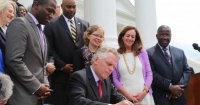 On Tuesday the Virginia Supreme Court heard arguments in a suit challenging Gov. Terry McAuliffe’s (D) April order that restored
 When Larry Harmon tried to vote on a marijuana initiative in November in his hometown of Kent, Ohio, the 59-year-old
 Virginia Governor Terry McAuliffe signed an order on Friday restoring the voting rights of more than 200,000 convicted felons who